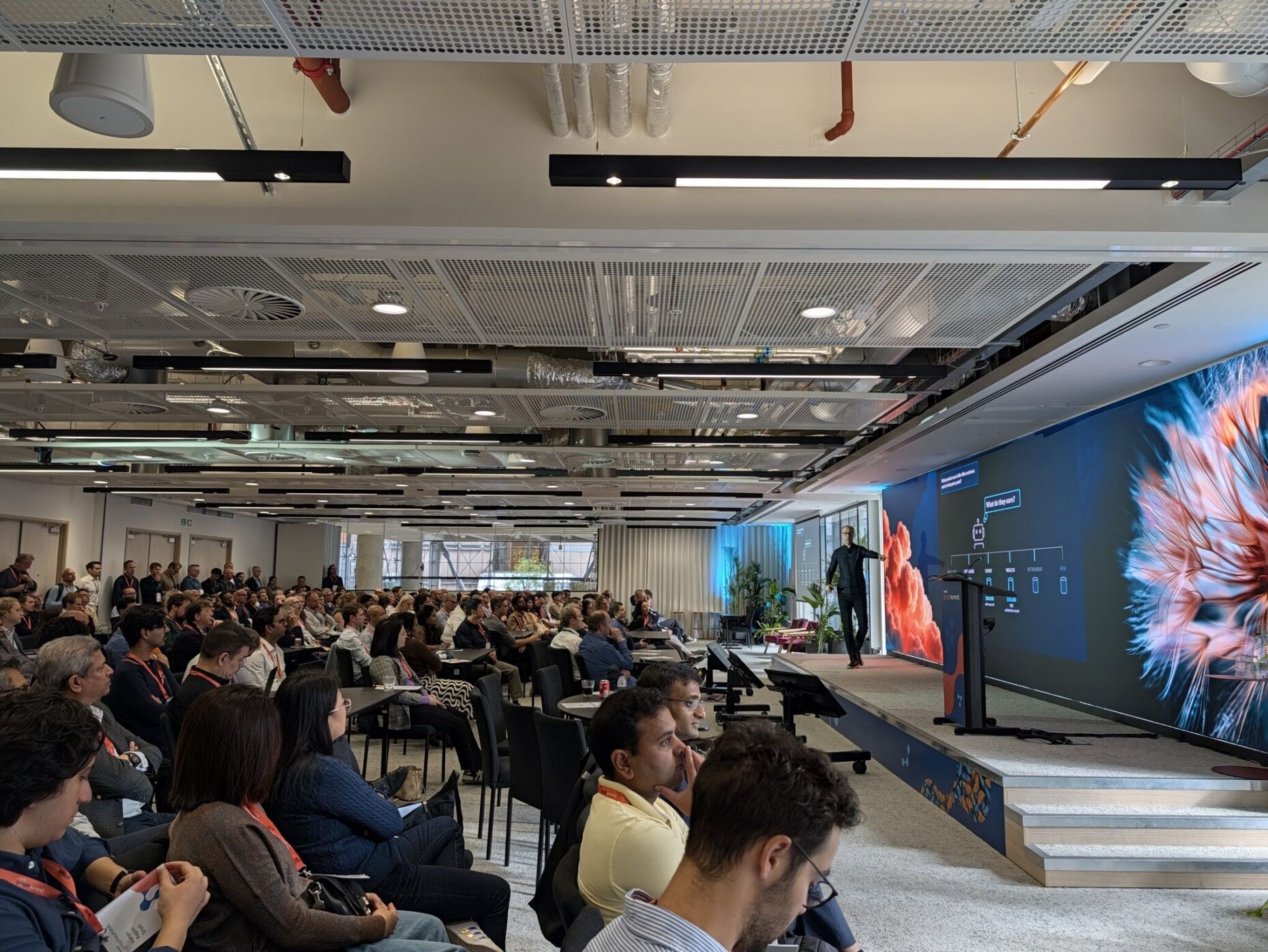
On 6 October I went to GraphSummit London, Neo4j’s conference. I cycled there, obviously. It is what I do most of the time. I stopped at the office first to change, then went in alone, because it looked interesting.
The day opened with a demo. Stephen Chin, who ran the event, has a home lab: a Proxmox cluster running agents, with a Neo4j instance on it for graph memory. The files that describe the lab’s network went into a vector database and a graph database, side by side, and both got the same questions about what was exposed.
The vector side decided pfSense was wide open. It was not. “It gets chunks and random things back and tries to make a story out of it,” Stephen said. The graph side ran real Cypher queries and got the right answer.
I know that story. When I joined Activate Intelligence at the start of 2024, before we used graphs, we tried different vector databases. Each one had its own problems. Chunking was one of them, and the models had much smaller context windows than they do now.
Then Emil Eifrem, Neo4j’s CEO, gave the keynote. The new models are uneven, “not perfect across every single dimension”. “But that’s not the bottleneck,” Emil said. “The bottleneck is giving the right data at the right time to these agents.”
The right data at the right time. At work we already do this.
At Activate Intelligence we build AIP, known around the office as “ape”. It starts from a simple problem: “Most of what an organisation knows evaporates.” AIP catches meetings, documents and decisions in a knowledge graph, and pulls out small claims, each with who said it and where. We call it a company memory.
By now it is just how we work. Whatever I am working on, I ask Claude to pull more from past conversations or from other parts of AIP. It comes naturally. Every conversation gets recorded. When one is not, it feels strange, and people ask each other: “Are you recording?”
So when the companies that use Neo4j took the stage, one after another, I kept hearing our own problem. This was the part that fascinated me.
An insurer, Inigo, called their talk “Connect, Don’t Collect”.
Capgemini talked about its work with AstraZeneca. They cut the time to deliver a data product “from four to six months down to four to six days”, then moved on to meaning. Does stock available mean physically present, or released and ready to use? Is the ID in one system the same thing as the ID in another?
A law firm, HSF Kramer, had “lawyers and business people” build a knowledge graph in eight hours, by talking to Claude. Raj Toora, from the firm, put it in five words: “The ontology is the product.” Raj also said the aim was for the firm to work “with the right information at the right time”.
The same sentence again.
An insurer, a drug company, a law firm. None of them connected, to each other or to us. In the morning Emil had said that over the last nine to eighteen months “everyone is now converging on exactly the same problem”. By the afternoon those three had shown it: a graph of what the business knows, meaning on top, and the model given what it needs when it needs it. AIP is that shape too.
The panel at the end came back to where I started. Had graphs replaced vectors? One of the Neo4j panellists split the question in two. Vector databases as a category “will have a very tough time”. Semantic search as a feature “is going to be very, very widely used even 10 to 20 years from now”.
We use it all the time inside AIP, to find similar content.
I also did the hands-on GraphAcademy session. It was too basic for me, so I spent it trying out Neo4j’s more advanced features instead.
I did not come away wanting to change anything at work. If anything, the day validated what we do: with graphs and LLMs, we are at the forefront, like the other companies in that room.
The models are smart, and they keep getting stronger on their own. The context is the part we do.