Most of my reading happens on the bike. Barking to the office and back, about an hour each way, a book in my ears the whole time. The last one was The Anarchy, William Dalrymple, read by Sid Sagar. I pick books partly on the narrator, and his was smooth, so I let it run the full two hours a day until it was done.
The thing I came away with is simple, and it still bothers me. A company conquered India. Not a country. A company.
India then was not one place. It was many kingdoms, and they spent most of their time fighting each other. The Mughal empire that once held them together was draining away slowly, had been since Aurangzeb died, and at one point a Persian king sacked Delhi and carried the throne off with him, and after that the centre never really held. That infighting is where the book gets its name. The anarchy. Into that a trading company walked, played one side against another, and took the lot. So many kingdoms, conquered by one company.
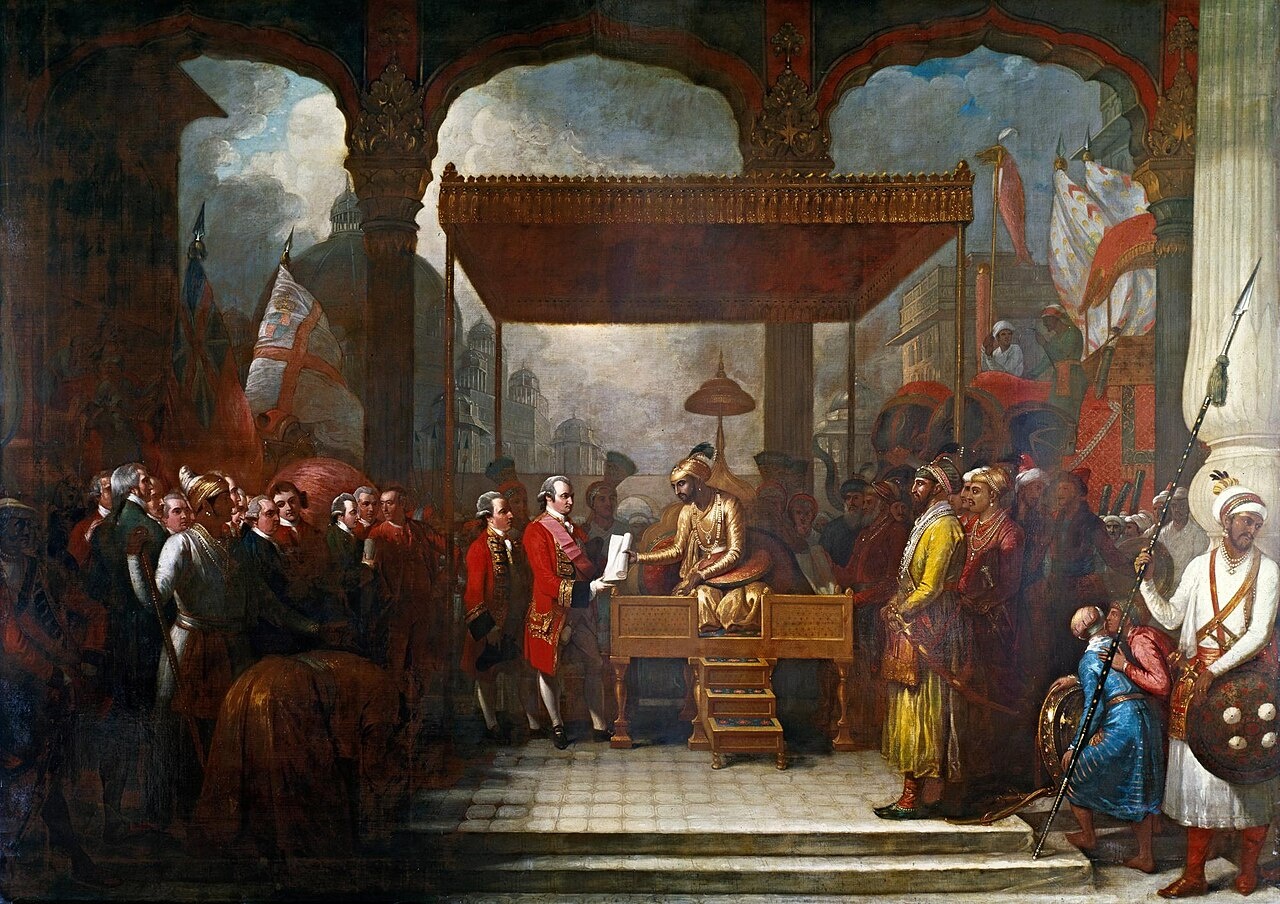
And it was not really done from the outside. The Company’s soldiers were mostly Indian. The money behind it was often Indian too, the big bankers backing the firm because a company that was predictable and paid was better for business than a local ruler who might not be. The battle that handed them Bengal was less won than bought, the other side paid to stand still while it happened. India was not simply taken. Parts of it were sold from the inside.
The man I kept following through it was Shah Alam, the Mughal emperor while all this went on. His life is hard to listen to. Exile, then a climb back, then a long fall, and at the bottom of it he was blinded, and his family was killed and worse, in his own palace. But he was not only a victim, and the book does not let you pretend he was. Plenty of times he chose not to fight. Twice he settled for a pension in exchange for lending the Company his name, which was about the only thing he had left that they wanted. He had a general, Mirza Najaf Khan, a Shia, the last good commander the Mughals had, brilliant in the field, who could have taken the throne for himself and never did. The court repaid that loyalty by turning on him. The men around the emperor were afraid of how strong he had grown, so they spread rumours and worked at him from the inside, the people he was protecting busy undermining him. He died worn out and ill, and Shah Alam came to him at the end and laid a hand on him as he went. After that there was no one left to hold any of it together. You keep waiting for someone in the story to stop it. Nobody does.
Even the resistance had a sad logic to it. Tipu Sultan, fighting in the south, wrote to Napoleon for help. I found that almost funny, in a bleak way. If Napoleon had come and won, nothing would have changed for the people there except the flag above them. One empire swapped for another. The only thing that could ever have stopped the Company was the kingdoms setting their fights aside and turning on it together, and they never managed it. Even a common enemy was not enough to put them in the same room. There was no version on the table where India came out of it free.
I started out with some sympathy for one or two of the Company men, Hastings among them. That did not survive. It went during the account of his impeachment back in London, when Edmund Burke stood up and laid out plainly what he had been, what he had wanted, how he behaved. I changed my mind about him in the space of a chapter, which is the sort of thing a good book can do to you.
I listened to a history of Genghis Khan not long before this one, and the two sit oddly next to each other. The Mongols killed on a scale that is hard to take in. But if you submitted to them you could live, even do well, inside the thing they built. Rome was similar. Bend the knee and there was a place for you. The Company was a colder thing than that. It did not want your submission. It wanted profit, and it took whatever paid, the wealth first, then the language, and it justified the cost the way a company always does, by what it returned to the people holding the shares. Most of the men who did the damage were not monsters. They were clerks and traders and soldiers doing their jobs, hitting their targets, signing the forms. Hannah Arendt had a phrase for that, the banality of evil: the worst things getting done not by villains but by ordinary people who were only doing what the job asked of them. A subcontinent taken apart, one ledger line at a time.
I do not feel hate reading it, which surprised me. I am here, in the life I have, partly because all of this happened the way it did. What I feel is closer to a low sadness. What the place might have been if it had been left to settle its own fights. The kingdoms were already at each other, granted, but the Company turned that into something far worse, and the damage did not end when the empire did. India, Pakistan, Bangladesh are still paying parts of that bill now.
History did manage one small joke, though. The Company never quite died. Its name was bought back, not long ago, by Indians, and for a while the firm that had bled India dry was an Indian-owned shop in London selling tea and jam and gold coins. It went into liquidation again last year. The thing that once ran a subcontinent could not keep a gift shop open.
Dalrymple makes a point near the end that I keep coming back to. The big companies today can be richer than whole countries, but they are not above them. They have money, not armies, and when one of them gets into real trouble it is usually its home government that steps in to save it. However large they look, next to the Company they are tamed beasts. The Company had its own army. It became a state. For a while I read that as a comfort, that it could not happen again, not like that.
Then I remember what I do all day. The companies that might actually shape what comes next are not the old giants. They are the ones building AI: OpenAI, Anthropic, a handful of others, building intelligence itself. This time it would not take an invasion. It might take a single event, one breakthrough, to set the thing running away from us. I work at a small company that lives and breathes this stuff, and I love the work, genuinely, which is the part that sits uneasily. Where I sit, we do not have power. Not yet.
The book left me with one last thing I cannot shake. The Company ran all of this from a building in the City, and the building is gone now, and the Lloyd’s building stands where it stood. It is a short ride from my office. I pass that part of town often without thinking about it. One company sat there and ran a subcontinent into the ground for the shareholders, and now there is glass and steel and people heading to meetings, and a man with a smooth voice in my ears telling me how it happened. I will ride past it again next week. I might stop this time.
Cover: Benjamin West, “Shah ‘Alam conveying the grant of the Diwani to Lord Clive”. Public domain, via Wikimedia Commons.